
01Introduction
Bioethanol is an important renewable alternative to fossil fuels. It can reduce greenhouse gas emissions, provide an additional revenue stream for farmers and strengthen the economics of the sugar industry.
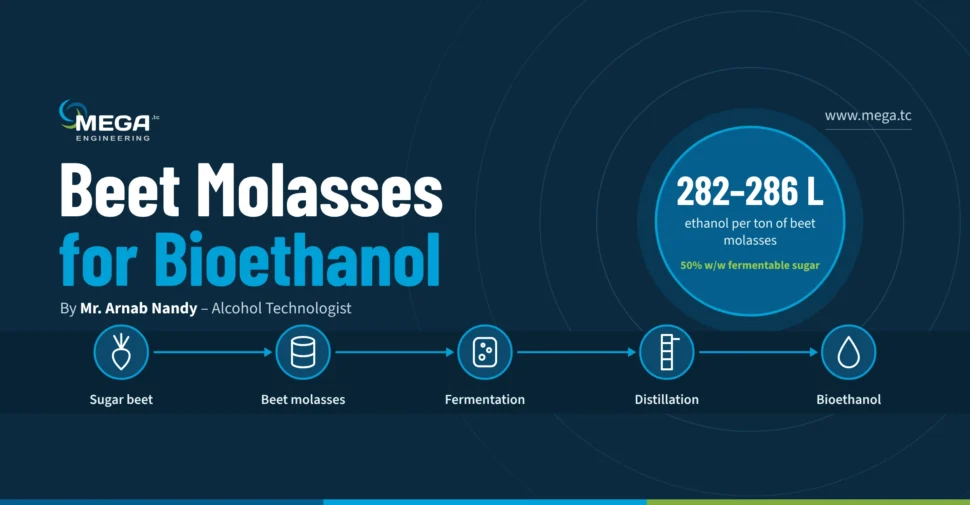
Sugar beet is an alternative to sugar cane as a source of sugar and already contributes part of the country’s sugar production. Beet molasses, the final by-product of beet sugar manufacture, is a well-proven raw material for bioethanol; Table 1 shows a typical specification. Each ton of beet molasses containing 50% w/w fermentable sugars yields about 282–286 L of ethanol, depending on fermentation efficiency and other process parameters. This corresponds to 87–88% of the theoretical yield of about 324 L.
Ethanol yield estimator
Based on the theoretical yield of about 324 L per ton at 50% w/w fermentable sugar.
This is an opportunity for the renewable energy sector: beet molasses ethanol supports fuel-ethanol blending targets, reduces energy imports and adds value to the sugar industry.
| Parameter | Unit | Value |
|---|---|---|
| Total solids | % w/w | 82 |
| Specific gravity | – | 1.40–1.45 |
| Temperature | °C | Ambient |
| pH | – | 6.5–8.0 |
| Fermentable sugar (FS) | % w/w | Min. 52 |
| F/N ratio* | – | 1.3 |
| Titrable volatile acids | ppm | < 16,000 |
| Total bacterial count | cfu/g | Max. 103 |
| Caramel content (0.1% w/v dilution) | Absorbance at 375 nm | Max. 0.3 |
| Free amino nitrogen (FAN) | ppm | Min. 1,500 |
| n-Butyric acid | ppm | Max. 100 |
| Settleable sludge | % w/w | < 1 |
| Calcium (as Ca2+) | % w/w | Max. 1.5 |
| Sodium | ppm | Max. 500 |
| Total inorganics | % w/w | Max. 10 |
* F/N ratio: ratio of fermentable sugars to non-fermentable solids in raw molasses.
02The pH problem
The most important feature of beet molasses for fermentation is its near-neutral to alkaline pH. In a beet sugar factory, the beets are sliced into thin strips called cossettes and the sugar is extracted with hot water in a diffuser. The raw juice is then purified with lime (liming and carbonatation), and the non-sugars, especially potassium and sodium salts, concentrate in the final molasses. As a result, beet molasses contains a considerable amount of alkaline salts and has a high buffering capacity: it resists any change in pH (see the pH and inorganics limits in Table 1).
Where each stream sits on the pH scale
Select a band for details.
The fermenting yeast, Saccharomyces cerevisiae, works best at pH 4.5–5.0, and an acidic mash also suppresses contaminating bacteria such as lactic and acetic acid bacteria, which grow well at neutral pH and consume sugar that would otherwise become ethanol. To reach this pH, a large dose of sulphuric acid is needed, considerably more than for cane molasses, because the alkaline buffering components in beet molasses neutralise much of the acid added. This acid has a cost of its own, and the sulphate it leaves behind becomes a problem in effluent treatment, as discussed later.
Why beet molasses needs more acid
Add sulphuric acid and watch each mash approach the yeast’s optimum.
03Nitrogen: a mixed blessing
An advantage of beet molasses is its high nitrogen content, considerably higher than that of cane molasses. Yeast needs nitrogen to grow, so this reduces the amount of nutrient that has to be added. However, a large part of this nitrogen is in the form of betaine, which S. cerevisiae cannot use. Only the free amino nitrogen (FAN in Table 1) is readily available, so nitrogen supplementation is reduced but not eliminated.
The amino acids in the mash also have a downside. Yeast converts some of them into higher alcohols, known as fusel oils. These must be removed carefully, especially when producing potable alcohol. They are separated during distillation as a fusel oil draw-off from the rectification column.
04Volatile acids
High volatile acidity is another concern. Volatile acids, mainly acetic, butyric and formic acid, are produced by bacteria during beet storage, processing and molasses storage. They inhibit the yeast and make it difficult to reach a high ethanol concentration in the mash. This matters because a higher ethanol concentration improves recovery in distillation and reduces the volume of effluent per litre of ethanol.
Volatile acids are most toxic in their undissociated form, and the proportion in this form increases as pH falls. Acidification and volatile acidity therefore work together to stress the yeast. If they are not measured and controlled, fermentation slows down and unfermented sugar remains at the end of the process.
How pH shifts volatile acids into their toxic form
Move the mash pH and see the share of each acid that is undissociated.
05Challenges compared with other feedstocks
Compared with cane molasses, cane juice and starch-based feedstocks such as maize or rice, beet molasses has some clear advantages. Its sugar is already in fermentable form, so no cooking, liquefaction or saccharification enzymes are needed. However, it also presents specific challenges, most of which come from the beet sugar process itself. They are described below and summarised in Table 2.
High alkalinity and buffering capacity
Cane molasses and cane juice are naturally acidic (around pH 5.0–5.5), so they need far less acid than beet molasses. The extra acid used for beet molasses increases chemical cost, adds to equipment corrosion and raises the sulphate content of the effluent.
High potassium and total ash
The ash of beet molasses is dominated by potassium salts. In high-gravity fermentation these create osmotic and ionic stress for the yeast, limiting the final alcohol strength. Lower alcohol strength means more effluent per litre of ethanol. The salts also contribute to scaling in distillation columns and evaporators.
Betaine
Betaine is characteristic of beet and is not present in significant amounts in cane molasses. Since yeast cannot use it, betaine passes unchanged into the effluent, adding to its organic load and nitrogen content. It can, however, be recovered as a valuable by-product.
Raffinose
Beet molasses contains the sugar raffinose. Ordinary distillery yeast ferments only part of it and leaves melibiose unfermented, causing a small yield loss. This can be recovered with α-galactosidase enzyme or with yeast strains able to ferment melibiose.
Nutrient imbalance
Beet molasses is poor in biotin, which cane molasses supplies in abundance, and is relatively low in phosphorus. Yeast propagation therefore usually needs phosphate and biotin supplementation, or blending with a small amount of cane molasses.
Nitrite
Nitrite, formed by bacteria from nitrate during processing and storage, can be present in beet molasses and becomes more toxic to yeast at low pH.
Contamination and foaming
Lactic acid bacteria, Leuconostoc and butyric acid-producing Clostridium species can grow in molasses during storage, which is why Table 1 limits bacterial count and n-butyric acid. Saponins and proteins from the beet also make the mash prone to foaming, which requires antifoam and reduces usable fermenter volume.
Seasonal availability
Beet is processed in a campaign of only a few months each year. A distillery that runs all year must store large volumes of molasses or use more than one feedstock. Beet molasses is also in demand for baker’s yeast, citric acid and animal feed, which affects its price and availability.
| Parameter | Beet molasses | Cane molasses | Grain (maize, rice) |
|---|---|---|---|
| pH before adjustment | 6.5–8.0, strongly buffered; high acid demand | About 5.0–5.5; low acid demand | Set by enzyme steps; moderate acid demand |
| Form of sugar | Mainly sucrose, plus some raffinose | Sucrose, glucose and fructose | Starch; needs liquefaction and saccharification |
| Nitrogen | High total N, much of it as betaine (not usable by yeast) | Low; N supplementation usually needed | Moderate; urea often added |
| Vitamins and minerals | Low biotin and phosphorus | Rich in biotin | Generally adequate |
| Ash and salts | High, potassium-dominated | High (potassium, calcium) | Low |
| Main inhibitors | Volatile acids, nitrite, salts | Volatile acids, caramel and Maillard products, salts | Mainly bacterial contamination |
| Availability | Short seasonal campaign | Seasonal crushing season | Year-round from stored grain |
| Effluent | Vinasse rich in K, betaine-N and sulphate | Vinasse with very high COD and dark colour | Stillage; solids recovered as DDGS animal feed |
Values are indicative and vary with region, factory practice and season.
06Treating beet molasses vinasse
Vinasse (also called spent wash or stillage) is the residue left at the bottom of the distillation column after the ethanol has been recovered. A molasses distillery produces about 8–15 L of vinasse per litre of ethanol, depending on the alcohol strength reached in fermentation. Beet molasses vinasse is a high-strength effluent. It is acidic (pH about 4–5), has a very high chemical oxygen demand (COD, typically tens of thousands of mg/L), and is rich in potassium, nitrogen from betaine, and sulphate from the acid used in fermentation. It cannot be discharged without treatment, and in practice a combination of the following measures is used.
Vinasse treatment toolbox
Select a measure for a summary, or show the typical scheme.
1Reduce volume at the source
The most effective first step is to produce less vinasse. High-gravity fermentation raises the alcohol concentration in the mash and so reduces vinasse volume per litre of ethanol. Part of the vinasse can be recycled as dilution water for the next fermentation, although salts and acids build up and limit how much can be reused. Accurate acid dosing also reduces the sulphate load.
2Concentration by evaporation
Vinasse is concentrated in multiple-effect or mechanical vapour recompression (MVR) evaporators to about 60–70% dry solids. The concentrate, known as concentrated molasses stillage (CMS), is an established commercial product in Europe. It is used as a liquid animal feed ingredient, where its betaine and nitrogen are valued in ruminant feed, and as a potassium–nitrogen fertilizer. The evaporator condensate is treated and reused as process or cooling water.
3Recovery of valuable components
Betaine can be recovered by chromatographic separation and sold for animal feed and cosmetics. Potassium can be recovered as potassium sulphate fertilizer by crystallisation. These steps turn part of the effluent problem into additional revenue.
4Anaerobic digestion to biogas
High-rate anaerobic reactors such as UASB, EGSB or internal circulation reactors convert most of the organic load into biogas, which can fuel the plant’s boilers or a combined heat and power unit. Beet vinasse needs particular care here. Sulphate is converted to hydrogen sulphide, which inhibits methane-producing microbes and corrodes equipment; betaine breaks down to ammonia, which is also inhibitory; and high potassium adds osmotic stress. Dilution or co-digestion, pH control, sulphide removal and biogas desulphurisation are used to manage these effects.
5Aerobic post-treatment
Anaerobic effluent still contains residual COD and a high ammonia load. Aerobic treatment with nitrification and denitrification removes most of the nitrogen. Where discharge standards require it, further polishing by coagulation, ozonation or reverse osmosis recovers water for reuse.
6Agricultural use
Diluted or digested vinasse is a valuable source of potassium and nitrogen for crops. Application rates must be based on soil analysis so that potassium and salt do not accumulate and groundwater is protected, and only within the limits set by local environmental regulations.
7Combustion of concentrated vinasse
Vinasse concentrated above about 60–65% dry solids can be burnt in specially designed boilers, usually with a support fuel, to generate steam. The potassium-rich ash can be sold as fertilizer. Together with evaporation, this route can achieve zero liquid discharge (ZLD).
A typical scheme
A beet molasses distillery will typically minimise vinasse volume through high-gravity fermentation and controlled recycling, recover betaine or potassium where the market justifies it, concentrate the remaining vinasse for sale as feed or fertilizer or burn it for steam, and treat the evaporator condensate for reuse. The best combination depends on local regulations, the market for by-products, energy costs and plant capacity.
07Conclusion
Beet molasses is a valuable feedstock for bioethanol, but it is not a simple substitute for cane molasses. Its alkalinity, high salt content, betaine, volatile acids and nutrient imbalances all require careful process control, and its vinasse needs a treatment strategy designed for its high potassium, nitrogen and sulphate content. By recognising these difficulties and controlling fermentation conditions, the sugar industry can achieve high ethanol concentrations and yields from beet molasses while turning its effluent into useful products.
08Glossary
- Betaine
- a nitrogen-containing compound found in sugar beet that yeast cannot use as a nutrient.
- CMS
- concentrated molasses stillage, evaporated vinasse sold as feed or fertilizer.
- COD
- chemical oxygen demand, a measure of the organic pollution load of water.
- FAN
- free amino nitrogen, the nitrogen yeast can readily use.
- High-gravity fermentation
- fermentation at high sugar concentration to reach a higher final alcohol strength.
- UASB
- upflow anaerobic sludge blanket, a type of high-rate anaerobic reactor.
- Vinasse
- the liquid residue left after distilling ethanol from fermented mash.
