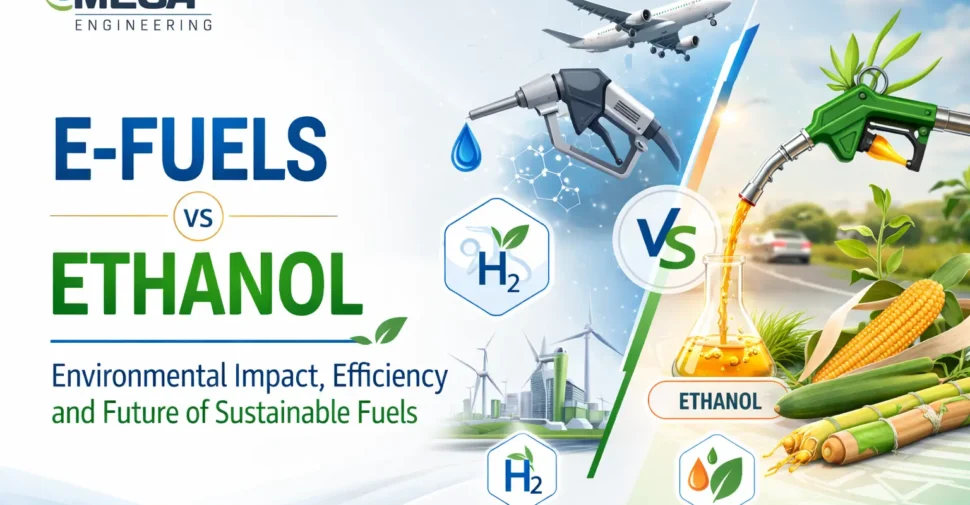

As the world moves toward sustainable energy solutions, alternative fuels are becoming increasingly important in reducing carbon emissions. Among the emerging options, E-fuels and ethanol are often discussed as potential alternatives to conventional fossil fuels.
Understanding the environmental impact of E-Fuels vs Ethanol is essential to determine which fuel can better support the transition to a cleaner and more sustainable energy future.
Environmental Impact of E-Fuels
The environmental benefit of E-fuels lies in their carbon-neutral nature. When produced using renewable electricity, E-fuels capture carbon dioxide (CO₂) from the atmosphere and convert it into fuel. When this fuel is burned, it releases the same CO₂ back into the atmosphere.
This process creates a closed carbon loop, potentially making E-fuels a sustainable option if they are produced using renewable energy sources.
However, the environmental impact of E-fuels is closely tied to the source of electricity used for their production. If the electricity is derived from fossil fuels, the carbon footprint of E-fuels becomes significantly higher, reducing their sustainability advantages.
Environmental Impact of Ethanol
Ethanol is considered a renewable fuel because it absorbs CO₂ during the growth phase of the crops used to produce it. When burned, ethanol emits CO₂, but much of this carbon was originally captured by the plants, creating a closed carbon cycle.
However, ethanol’s environmental benefits can be affected by factors such as land-use change. If forests or wetlands are cleared to grow biofuel crops, this can result in significant carbon emissions that offset the environmental advantages of ethanol.
Additionally, the production process itself—including transportation and processing—requires energy, which may increase its overall carbon footprint.
Energy Efficiency and Application
E-Fuels
One of the challenges of E-fuels is that they are less energy-efficient compared to battery electric vehicles. The process of converting electricity into hydrogen and then into synthetic fuel involves several stages, each causing energy loss.
However, E-fuels offer an important advantage in sectors that are difficult to electrify, such as aviation, shipping, and heavy-duty trucking. In these sectors, E-fuels could provide a low-emission alternative to conventional fuels.
Ethanol
Ethanol is less energy-dense than gasoline, which means vehicles running on ethanol tend to have slightly lower fuel efficiency. However, ethanol blends such as E10 are already widely used in India.
Increasing the blend to E20 could help improve energy security while lowering emissions. Unlike E-fuels, ethanol is compatible with existing infrastructure and can be used in internal combustion engines without major modifications, making it a practical short-term solution for India.
Cost and Economic Viability: E-Fuels vs Ethanol
E-Fuels
The high cost of producing E-fuels remains one of their biggest challenges. The production process is energy-intensive and requires significant technological advancements to become cost-competitive with conventional fuels.
Currently, E-fuels are largely uncompetitive without substantial government support or carbon pricing mechanisms.
India, with its strong renewable energy sector, could potentially lower production costs in the long term. However, scaling up E-fuel production will require major investments in infrastructure, research, and development.
Ethanol
Ethanol is relatively cheaper to produce, particularly in countries with strong agricultural sectors such as India. Government policies and subsidies have supported ethanol production, helping reduce costs.
In addition, the infrastructure for producing, blending, and distributing ethanol is already in place, making it an attractive option for immediate adoption.
However, ethanol production can be influenced by agricultural output, and increasing ethanol blends may require further scaling of production capacity.
Which Fuel Holds Greater Potential for India?
When comparing E-Fuels vs Ethanol, both fuels have a role to play in India’s transition to a sustainable energy future.
Ethanol is a ready-to-use solution for reducing emissions in India’s transportation sector. Its established production infrastructure and compatibility with existing vehicles make it a practical and scalable option. It also helps reduce oil imports and supports rural agricultural development.
E-fuels, while still in the early stages of development, offer significant potential for sectors that are difficult to electrify, such as aviation, shipping, and heavy transport.
Which Fuel Holds Greater Potential for India?
Both E-fuels and ethanol can contribute to reducing carbon emissions and supporting the transition toward sustainable fuels. However, they serve different purposes.
Ethanol currently represents a practical and cost-effective solution for immediate implementation, particularly in countries like India with strong agricultural resources.
E-fuels, although still developing, may become an important long-term solution for sectors that cannot easily transition to electric power.
Understanding the differences between E-Fuels vs Ethanol will help industries and policymakers make informed decisions about the future of sustainable energy and transportation.
Mega Engineering - All Rights Reserved.
Powered by