
As industries and governments increasingly focus on renewable energy, biogas has emerged as a sustainable alternative to conventional fuels. However, raw biogas contains impurities such as carbon dioxide (CO₂), hydrogen sulfide (H₂S), moisture, and trace gases that must be removed before it can be used as Bio-CNG or injected into natural gas grids.
The process of removing these impurities is known as biogas purification or upgrading. Among the various technologies available, Water Scrubbing, Pressure Swing Adsorption (PSA), and Membrane Separation are the most widely adopted.
1. Water Scrubbing Technology
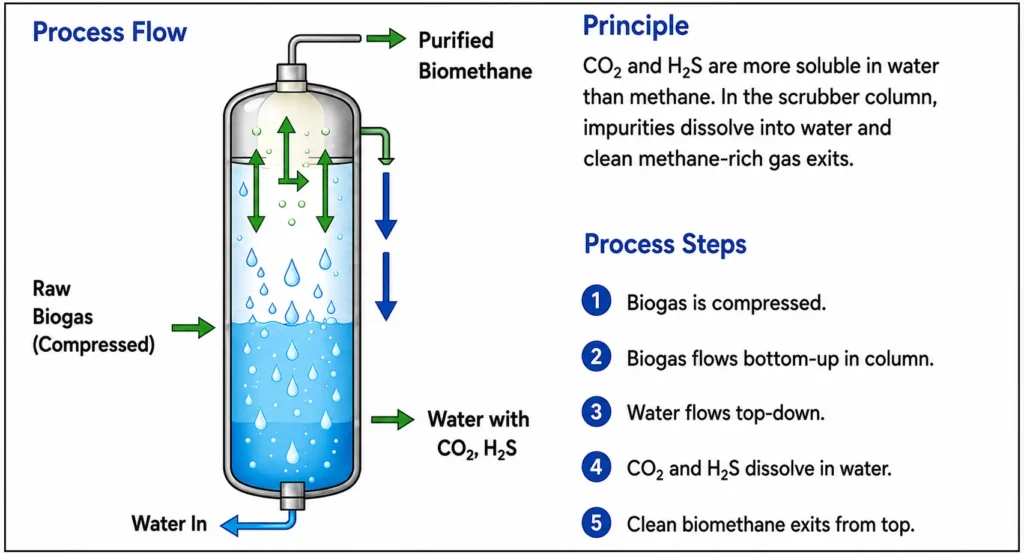
Water scrubbing utilizes the higher solubility of CO₂ and H₂S in water compared to methane. Raw biogas is passed through a water-filled absorption column where impurities dissolve in water, leaving methane-rich gas at the outlet.
Advantages
- Proven and mature technology
- High methane recovery rates
- No chemical consumption
- Suitable for medium to large-scale plants
- Relatively simple operation
Disadvantages
- High water consumption if water is not recycled
- Larger equipment footprint
- Additional treatment required for wastewater
- Higher energy requirement for water circulation
Best Suited For
Projects with reliable water availability and medium to high biogas production capacity.
2. Pressure Swing Adsorption (PSA)
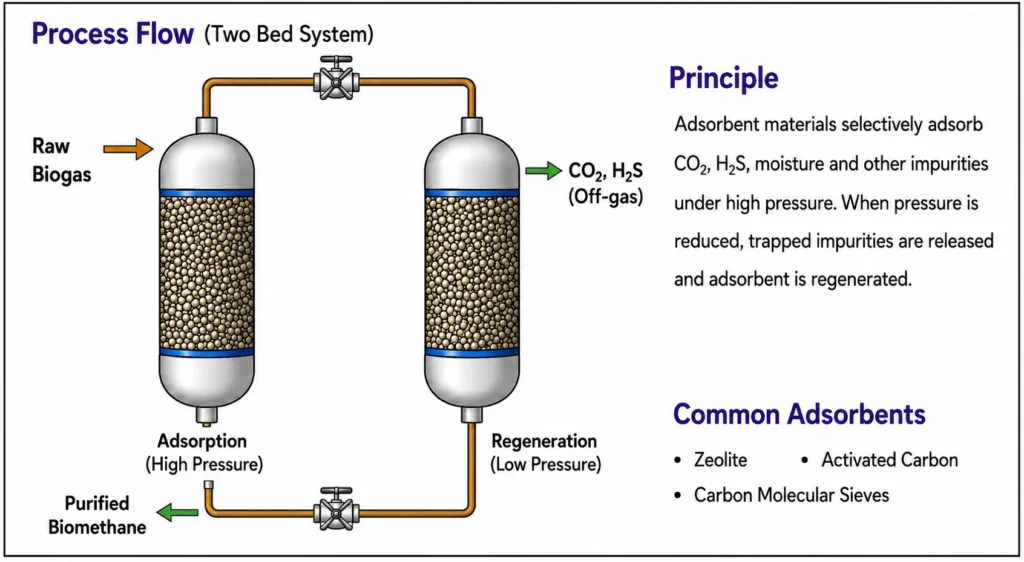
PSA technology separates gases based on their molecular adsorption characteristics. Under pressure, impurities such as CO₂, H₂S, and moisture are adsorbed onto specialized adsorbent materials while methane passes through. The adsorbent is then regenerated by reducing pressure.
Advantages
- Produces high-purity biomethane (up to 98–99%)
- Low water requirement
- Modular and compact design
- Automated operation
- Suitable for varying gas compositions
Disadvantages
- Higher capital investment
- Periodic replacement of adsorbent materials
- Methane losses can occur during regeneration
- Sensitive to feed gas contaminants
Best Suited For
Industrial-scale Bio-CNG projects requiring high methane purity and minimal water usage.
3. Membrane Separation Technology
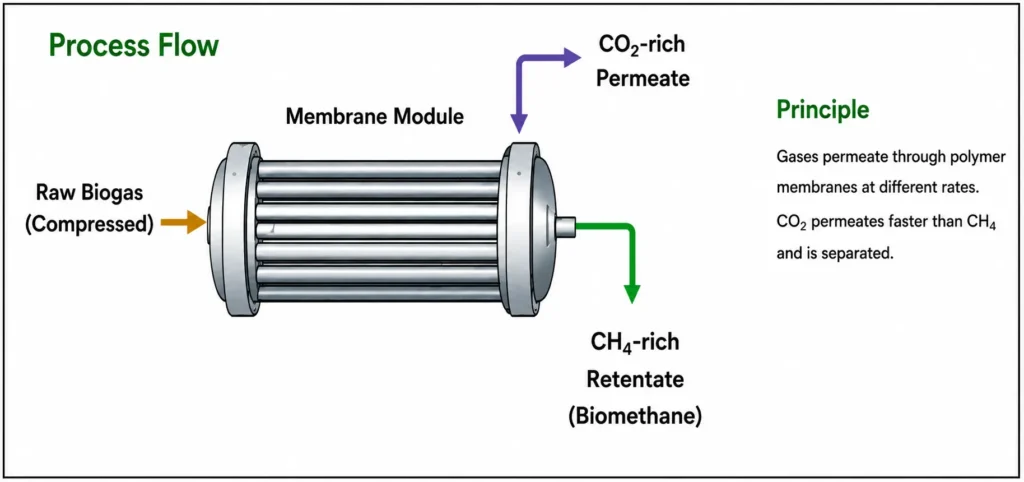
Membrane systems use selective permeable membranes that allow CO₂ and other smaller molecules to pass through while retaining methane. Multiple membrane stages can achieve high methane concentration levels.
Advantages
- Compact and modular design
- Low maintenance requirements
- Minimal moving parts
- Low water consumption
- Easy scalability and capacity expansion
Disadvantages
- Membrane replacement costs over time
- Performance affected by contaminants and moisture
- Requires pre-treatment of biogas
- Multiple stages may be needed for very high methane purity
Best Suited For
Modern decentralized plants and projects where space efficiency and scalability are important.
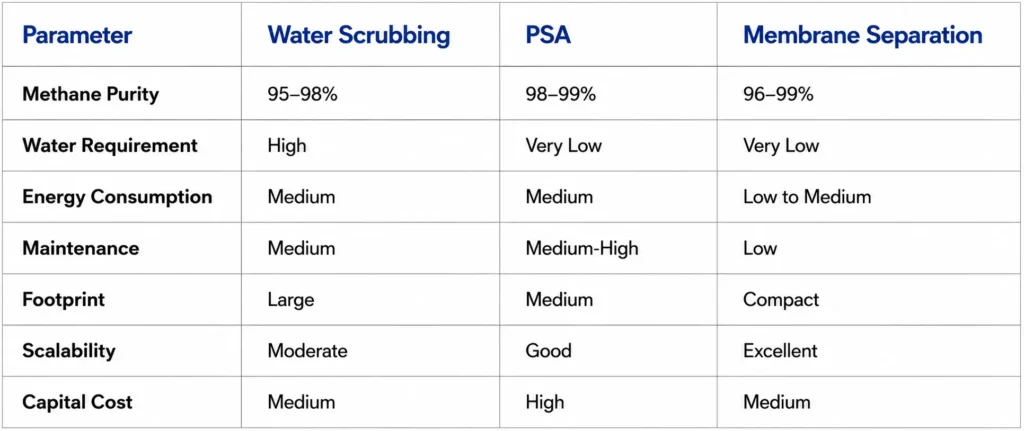
Technology Comparison
Conclusion
There is no single “best” biogas purification technology. The optimal choice depends on project size, desired methane purity, water availability, operating costs, and long-term scalability requirements.
- Water Scrubbing remains a reliable and proven solution for large-scale applications where water is readily available.
- PSA offers superior gas purity and operational flexibility for industrial Bio-CNG projects.
- Membrane Separation is gaining popularity due to its compact design, lower maintenance, and ease of expansion.
A thorough technical and economic assessment should be conducted before selecting the most suitable upgrading technology for a biogas project.
Mega Engineering - All Rights Reserved.
Powered by