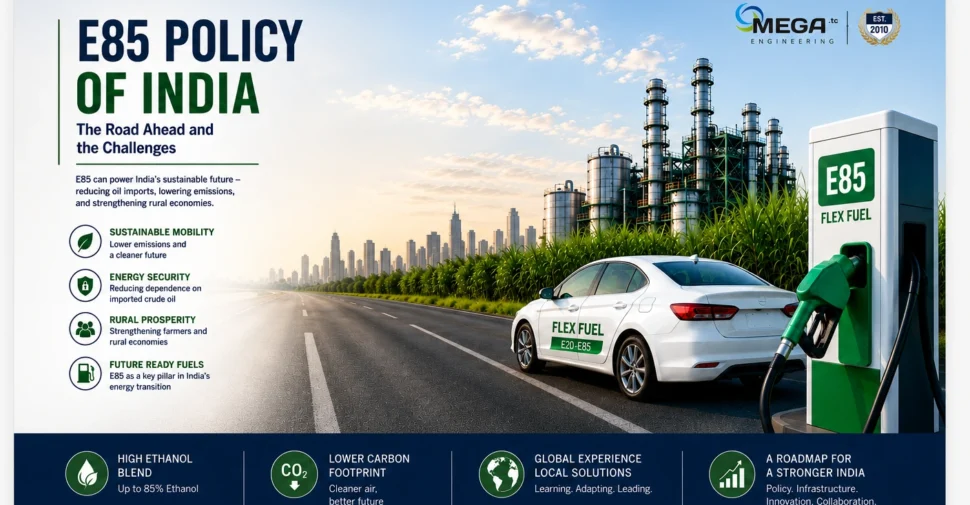

India’s Ethanol 85 Story Is Entering a More Demanding Phase
India’s energy transition is often framed around electrification, renewable power, and green hydrogen. Yet liquid biofuels remain an important part of the country’s transport decarbonization strategy because they can reduce crude oil dependence, support rural incomes, and work within much of the existing fuel ecosystem. In that context, E85—a fuel blend containing up to 85% ethanol and 15% petrol—has emerged as an important next-step discussion in India’s mobility policy landscape.
Why E85 Matters
E85 offers reduced crude oil imports, lower lifecycle emissions, rural economic development, and greater diversification of transportation fuels. Countries such as Brazil and the United States have demonstrated the viability of higher ethanol blends as part of national energy security strategies.
Current Policy Landscape
India’s biofuel push has accelerated under the National Policy on Biofuels and the Ethanol Blended Petrol programme. The country advanced its E20 target to the Ethanol Supply Year 2025–26, and official updates in March 2025 reported blending at 17.98% up to 28 February 2025. At the same time, the policy conversation has begun expanding toward flex-fuel vehicles and the regulatory conditions required for higher ethanol blends. However, as of March 2025, the government had stated that no decision had yet been taken to raise blending beyond 20%.
Key Challenges on the Road to E85
The case for E85 is strategically compelling, but scaling it in India will require much more than a higher blending target. Feedstock sustainability, vehicle compatibility, retail infrastructure, pricing, environmental safeguards, and regulatory clarity will all shape whether E85 becomes a practical fuel option or remains a niche proposition.
Feedstock Availability and Sustainability
A credible E85 pathway cannot rely too heavily on one feedstock. India’s progress so far has depended substantially on sugarcane-linked ethanol, but scaling higher blends raises legitimate concerns around water intensity, regional concentration, and food-versus-fuel trade-offs. A more resilient strategy would expand grain-based ethanol where appropriate, accelerate second-generation pathways, and build long-term capacity around agricultural residues, municipal organic waste, and cellulosic technologies.
Vehicle Compatibility
E85 is not a drop-in fuel for the existing vehicle fleet. Large-scale adoption depends on flex-fuel vehicles designed with ethanol-compatible fuel systems, corrosion-resistant materials, revised engine calibration, and stronger cold-start performance. That makes OEM readiness and consumer education just as important as fuel availability.
Fuel Distribution Infrastructure
Even if ethanol supply rises, nationwide availability will take time. Retail deployment requires dedicated storage, compatible dispensing systems, segregated logistics, and consistent quality-control practices across fuel stations. Without a phased infrastructure buildout, E85 may remain confined to limited urban pilots or select corridors.
Learning from Brazil
Brazil’s experience shows that high-ethanol adoption works best when fuel policy, vehicle technology, and consumer economics evolve together. Its flex-fuel ecosystem benefited from long-term policy continuity, widespread vehicle compatibility, tax differentiation, and broad retail availability. The lesson for India is not to copy the model mechanically, but to build a similarly coordinated ecosystem over time.
The Road Ahead
The most realistic path is phased rather than abrupt: consolidate E20, expand flex-fuel vehicle availability, build targeted Ethanol 85 infrastructure, diversify sustainable ethanol feedstocks, and create clear pricing and regulatory signals for consumers and manufacturers. In other words, India’s E85 future—if it materializes at scale—will be built through system readiness, not ambition alone.
Conclusion
India’s interest in E85 reflects a broader strategic goal: reducing oil dependence while building a lower-emissions and more diversified transport system. But the transition will succeed only if policy ambition is matched by sustainable feedstock planning, flex-fuel vehicle deployment, infrastructure investment, and consumer confidence. The opportunity is real, but so are the constraints—and the quality of execution will determine whether E85 becomes a meaningful part of India’s mobility mix.
Mega Engineering - All Rights Reserved.
Powered by
One Reply to “India’s E85 (Ethanol 85) Ambition: Opportunity, Readiness, and the Roadblocks Ahead”
Rushikesh Pawar
Great read.